
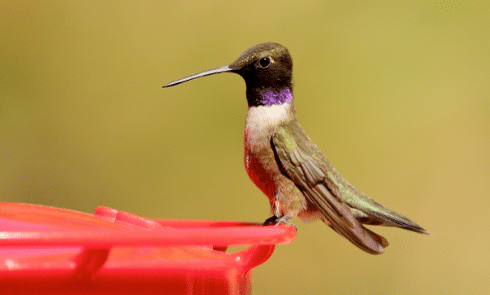
 A Black Chinned Hummingbird. Photo by Bob Walker, PEEC Nature Center
By ROBERT DRYJA
Los Alamos
Spring is approaching and birds will be migrating in a month.
This migration is not random flying but involves two considerations:
- Time; and
- Direction of a flight.
The first consideration is presented in Chart 1 (below). Black chinned hummingbirds arrive routinely in the first week of April and are gone by the end of October.
The second consideration relates to the the direction of migration. Hummingbirds know which way to fly as well as when to fly. They fly southward for the winter to Mexico and toward the Pacific Ocean coast. This may be a distance of 500 to 1,000 miles, depending on where they start. Remarkably they return to their starting location in the spring, another 500 to 1,000 miles. Two types of knowledge are needed to migrate in the correct direction.
First, they need to sense their starting point. Second, they need to have a sense of direction to fly from their starting point and then back to it. Hummingbirds can return in the spring to the same place they left in the fall. The changing angle of the sun from day to day may provide the stimulus for when to begin flying southward or northward. The pattern of the magnetic field may provide guidance along the flight path.
Hummingbirds fly by themselves, not in a group. What does a fledgling hummingbird think when it is starting to migrate for the first time for hundreds of miles? There are no other knowledgeable hummingbirds with which it can fly. It appears that a hummingbird inherits genes that include the information to direct its first migratory flight. The experience of repeated migration flights over the years builds upon this inherited knowledge. Research shows that hummingbirds also can remember the flowers they have visited for nectar. They can sense how long to wait between visits so flowers have time to generate new nectar.
This ability to select where to feed can be observed when a set of hummingbird feeders are placed in a row. The hummingbirds return repeatedly to one particular feeder in the row, sipping it dry. Only then do they shift to another feeder. This pattern makes sense when considering how much energy a hummingbird uses. Hummingbirds have a heartbeat of about 250 per minute while resting and 1,260 per minute while flying. Better to fly to a known location with food instead of flying randomly to find a source.
All of the preceding examples of learning are more remarkable when the size of a hummingbird’s brain is considered. A black-chinned hummingbirds weighs 2.7 to 4.2 grams. Their brain weighs 0.11 to 0.17 grams. This is equivalent to 0.004 to 0.006 of an ounce. A human brain weighs about 48 ounces in comparison. How many of us could walk 1,000 to 2,000 miles each year with no maps and find food growing along the way? How many of us could find our way back to our starting point?
Being “bird brained” is really a compliment. Appreciate what a hummingbird has done when you see it for the first time this April. You may want to report the birds that you see to the two programs of the Cornell University Department of Ornithology. Report to https:////feederwatch.org if you set up a hummingbird feeder. Alternatively, report the birds you see when walking about to https:////ebird.org.
 Chart 1, shows the average feederwatch weekly sightings of Black Chinned Hummingbirds from 2017-2021. Courtesy/Robert Dryja
 Chart 2, shows where black chinned hummingbirds occur during a year. Location by time of year: Feb. 22-May 24: Pre-breeding migratory season to the far north (Gold); May 31-July 20: Breeding season (Red); July 27-Nov. 23: Post-breeding migratory season south to Mexico (Gold); Nov. 30 -Feb. 15: Non-breeding season on southern/coastal Mexico (Blue). Courtesy/Ebird, Cornell University Department of Ornithology