

Clergy from left, Deacon Amy Schmuck, Deacon Cynthia Biddlecomb, retired, The Rev. Mary Ann Hill and The Rev. Lynn Finnegan. Photo by Nate Limback/ladailypost.com
By Deacon Cynthia Biddlecomb
ELCA, retired
In the eighteenth chapter of Genesis, Abraham and Sarah, the couple chosen as progenitors of the People of God, receive a visit. Living in a tent, in an inhospitable wilderness, they would offer hospitality to anyone who came by. In this case, their visitors were a trio of holy ones, come to bring further news of God’s promise to them.
The story is a favorite of mine. In it we have the tradition of hospitality to the stranger offered in acknowledgement that conditions were difficult. Anyone passing by would need a cup of water and perhaps a bit of food to survive. Hospitality to the stranger is a key tenet of this faith in God. This is probably where we get our image of the necessity of treating others well; we never know when we might unknowingly be showing kindness to angels. Indeed, in the Letter to the Hebrews 13:2 we are admonished: “Do not neglect to show hospitality to strangers, for by doing that some have entertained angels without knowing it.”
This is also a story that confirms God’s surprising promise to Abraham, that he will have more descendants than there are stars in the sky. Being impatient, Abraham had been having doubts. But the visitors proclaim to him that he will have a son with Sarah, a son through whom the promise will descend. Being of advanced age, Sarah laughs when she overhears the promise. This good news is astonishing, but when eventually she does give birth, she calls her son “Isaac”, which in Hebrew means “laughter”. They wanted to remember that God’s surprising promise, fulfilled, brought them delight and laughter.
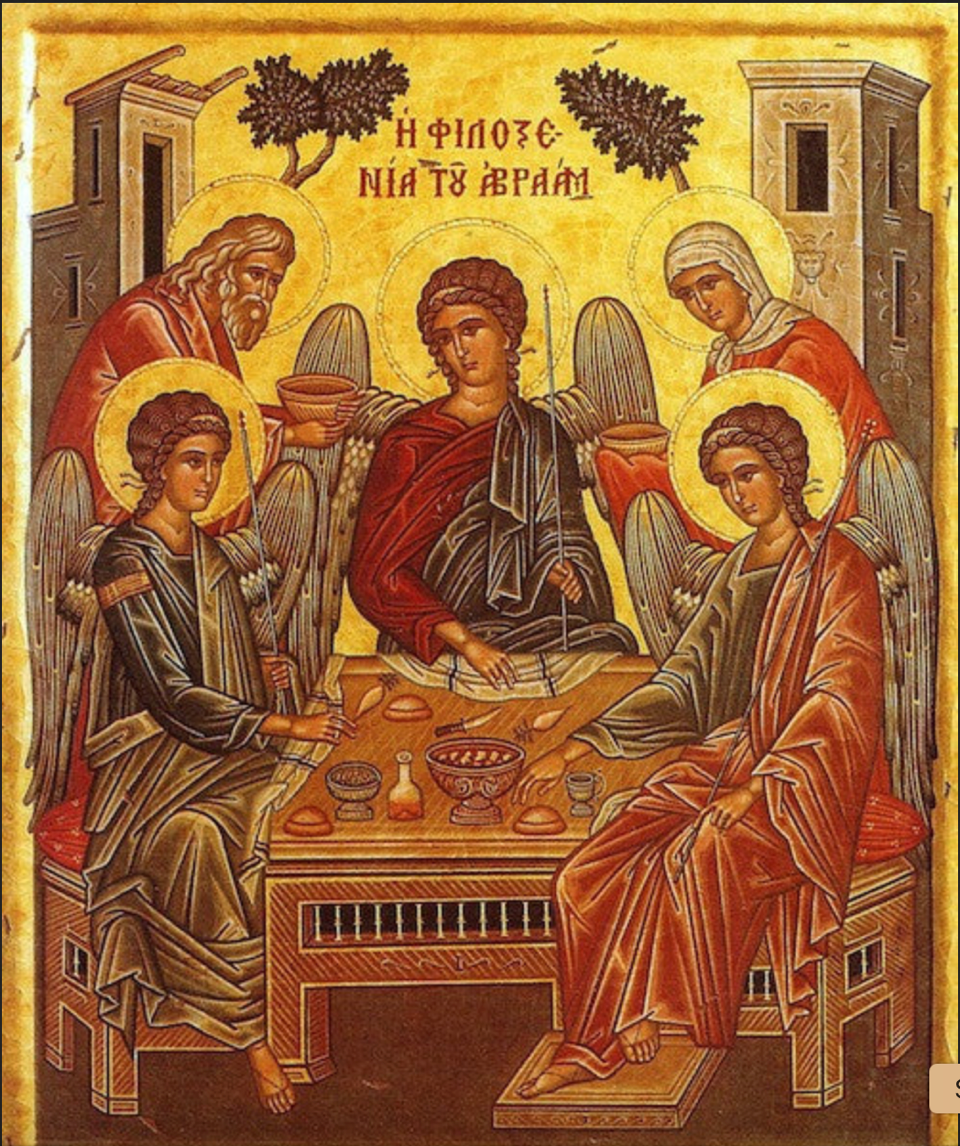
On a visit to Greece many years ago, I found an icon depicting this story of the trio of visitors, seated at table, being served by Abraham and Sarah. I was familiar with the famous Russian icon of the scene, painted by Andrei Rublev in the 15th century, but it does not show them hosting. The icon I saw in Meteora, “written” in the Greek tradition, shows them bending over their visitors, offering hospitality and sustenance. I just had to buy it.
A very long time ago, Christian biblical hermeneutics determined that these three visitors represent the Holy Trinity. One of them speaks and, in the icon, blesses the food, and the couple, with the others. They represent the Godhead as a relationship. One might say that the one speaking is the Creating Word, one is the eternal and redeeming Christ, and the third is the sustaining Spirit of God, “the three in one”, as we often say in church. The Trinity is a mystery, God in three persons, three ways in which the Divine One is made known to us.
It is a very early story, helping us to contemplate the Holy Trinity. The Hebrew text does not explain it as such. But for Trinitarian believers, here is God’s presence manifested to this old couple in whom the promise will be lived out, along with their joy-filled laughter.
Editor’s note: ‘All Shall Be Well’ is a column written by local women clergy including The Rev. Mary Ann Hill, Rector, Trinity on the Hill Episcopal Church (momaryannhill@gmail.com); The Rev. Lynn Finnegan, Associate Rector, The Episcopal Church of the Holy Faith, Santa Fe (rev.lynn@holyfaithchurchsf.org); Deacon Amy Schmuck, Bethlehem Evangelical Lutheran Church (deaconamy@bethluth.com); and ELCA Deacon Cynthia Biddlecomb, M.Div., retired (czoebidd@gmail.com).
 Courtesy image