
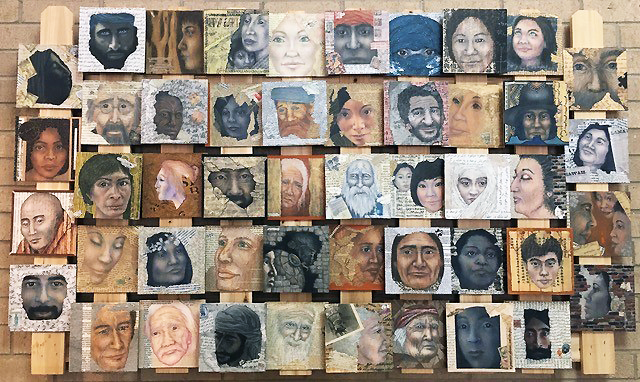
 ‘One World’ 5.5 Feet Long By 4.5 Feet High lunch buffet and talk Jan. 30 at SFCC. Courtesy image
Santa Fe World Affairs Forum News:
The community is invited to a lunch buffet and talk by artist-story teller Jeannie Hope Gibson noon to 2 p.m. Thursday, Jan. 30 in the Board Room (#223) at Santa Fe Community College (SFCC).
Even with our vast personal differences or location on this earth, we are all interconnected, an extended family. Migrations and intermarriages throughout our human history have impacted our DNA, altering our bloodlines. These are average everyday people from all over the world who share common ground far greater than their personal differences or their countries of origin. They have suffered from wars, famine, natural disasters, health issues, deaths of loved ones or other personal heart breaks. For some life has crushed their spirits and fractured their vision of hope.
“I began drawing people when I was three years old,” Gibson said. “My journey started as an in-depth study of the many different facial features I saw growing up in Santa Fe. Later during my travels out of the country, my interest grew into a desire to reflect each person’s personal history and lineage. Through the years I sat wherever there were people, sketching on napkins, scraps of newspaper, old letters, books, maps, or whatever I found around me. Some I knew personally, and several were described by a relative or someone who knew them. Each face is drawn or painted and buried under layers of ephemera reflecting the blending of many complex cultures added over time to their individual’s life experiences.
“Because there are many layers to a person’s life, I use collage to frame the faces, adding depth to their story. They are surrounded by yellowed pages from old books or maps written in their native languages. Only when we peel back those layers of time and experience, will we reveal the true spirit underneath. I think of it as an archeological excavation, where each small, fractured sherd or bone fragment combines with thousands more relics to tell the person’s personal story. One by one we all contribute to our complex history, sharing the journey of our human family.
“Their images rest together on a picket fence, which is open and welcoming. They could be neighbors talking peacefully to each other over that fence, sharing their stories freely with mutual acceptance. A wall is too rigid and shuts people out, but neighbors linger and visit over a fence; in time building trust, understanding and eventual friendship. No matter their language, personal faith, racial heritage, or DNA, they all share the same experience of simply being human.”
 Artist-story teller Jeannie Hope Gibson
I was born in Gallup and grew up among the Navajo and Zuni people. My grandfather owned the Gallup Independent, and my aunts lived and taught at Zuni Pueblo. We spent many hours at our friends ‘ceremonial dances, where I first remember sitting on a Navajo rug watching flames from the flickering campfires join in the swirling colors of the dancers, casting huge shadows of motion on the towering red cliffs next to us. As the drums pounded their rhythmic beat, and the singers changed, the echos bounded off the towering rock walls and filled me with a sense of peace and wonderment.
While my retirement as a paralegal is from Lockheed/Martin, my love for the arts never took a back seat. My formal studies in painting and sculpture began at 13 at the Corcoran Gallery and School of Art in Washington, DC. Later working on Capitol Hill in D.C., I continued studies at the Corcoran.
Archeology is my greatest passion, next to painting. For a number of years since 1990, I assisted in recording ancient rock art panels which were included in the official recordings for the state of Colorado. I have spent many hours in a tent precisely copying bison bones in situ at a large excavation in Nebraska. As a member of the Colorado Archeological Society, I was dedicated to all efforts to preserve countless Ancient Puebloan sites from further weathering or vandalism, volunteering for work at site such as Ute Mountain Tribal Park near Mesa Verde. Several of my drawings of local area rock art panels are included in the permanent collection at the Rio Grande Museum in Del Norte, Colo.
Registration: This SFWAF lunch is $25 for members and $35 for nonmembers. To register you may either pay by check made out to SFWAF and mailed to the Santa Fe World Affairs Forum, PO Box 31965, Santa Fe, NM 87594 or by credit card through Paypal. Please indicate on your check – or if using Paypal (“add special instructions to the seller”) that your payment is for the Thursday, Jan. 30, 2025 program: https://sfwaf.org/payment/
If you are not a member yet or plan to bring a nonmember guest, please include your best contact information and your guest’s name. If you are interested in membership or inclusion on our email list please email us: sfwaforum@outlook.com
Payment for this program is nonrefundable after Jan. 23, 2025. We strongly prefer that payment be made by Paypal or check postmarked by Jan. 23, 2025, to facilitate check-in and caterers’ needs. If you are mailing a check, please also email us at sfwaforum@outlook.com to be sure we know you plan to attend.
Location: SFCC Board Room (#223) is in the West Wing (Administration building). The college is located at 6401 Richards Ave., Santa Fe, NM 87508. Enter through the building’s main entrance (on the left side of the building behind the flag poles). The Board Room is on the corridor to the left of the Campus Center.
Directions: From Rodeo Road turn south onto Richards Avenue. Turn into the campus main drive. Parking lots are in front of the building. Park in the East Wing Parking Lot to the right of the main entrance. If you enter through the Administration building take the corridor to the right just before the student center and cafeteria to enter the East Wing. From I-25 take the Cerrillos Road exit, turn east onto Governor Miles Road and then right onto Richards Avenue. Then follow the directions above.