
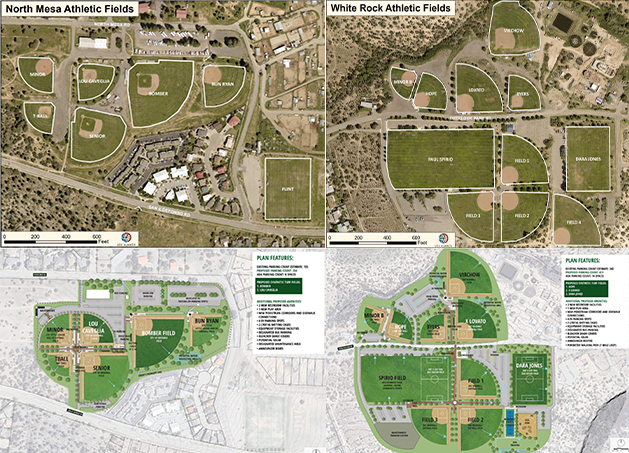
 These images show how the North Mesa and White Rock athletic fields look now versus how an artificial turf feasibility study proposes they could look in the future. Click here for more detailed images. Courtesy/LAC
By KIRSTEN LASKEY
Los Alamos Daily Post
kirsten@ladailypost.com
Turf that is neatly trimmed, perfectly leveled and colored a single shade of green could be in the future for several athletic fields on North Mesa and in Overlook Park. Not because of some breakthrough in sod botany but because Los Alamos County installs artificial turf.
If the County follows through on this project, it will have some guidance. During the Los Alamos County Council meeting Oct. 28, a report was presented on how the artificial turf plans could be rolled out.
No action was taken; in fact, it was emphasized during the meeting that the recommendations in the report simply offer information for any future decisions regarding artificial turf.
The consultant for the project, NV5, made the presentation during the meeting.
Project lead Ania Pastuszewska called the report, “a toolbox and it is a collection of information that can be referred back to when master plan efforts are undertaken.”
Sites Southwest Landscape Designer Shasta Meehan unveiled what could potentially be done at the two athletic complexes.
Regarding both sites, she said the proposed improvements extend beyond just laying down artificial turf to include enhancements to accessibility, pedestrian safety and functionality. Improvements would also be made to the lighting at the complexes.
At North Mesa, it is proposed to improve the pedestrian corridor, move the Minor, T-Ball, Lou Caveglia and Senior fields closer together and extend some of the fields’ sizes. Other improvements are offering a playground, and amenities such as restrooms and concession stands. It is also suggested to move the parking lots. The two fields proposed for artificial turf installation are Bomber Field and Lou Caveglia Field.
Meehan added that the current layout is disjointed; there is no central parking and there are limitations in field sizes. She said that there are also grading challenges, which prohibit improvements to accessibility and ADA compliance.
For Overlook Park, Meehan said some fields would be rearranged on the north end for centralized parking. To achieve this, X Lovato and Byers Fields would be switched. Some fields would stay in place such as Hope and Minor B but there would be user friendly parking and pedestrian corridors throughout Overlook Park. Design improvements at Field 4 propose amenities such as a dog park, a basketball court and a separate facility for dog training. Artificial turf would be installed at Hope Field, X Lovato and Dara Jones fields.
Neither plan comes cheap.
For each complex, Meehan offered base cost, which would just cover basic improvements and a second cost estimate that considers framework plans and additional recommendations. The estimates have a five-year phase plan that would start in 2028 and have a 10-year timeline.
The base cost for North Mesa is $16.3 million. The cost estimate for the framework plan is divided into four phases and each total approximately $5 million.
As for Overlook Park, Meehan said the base cost is $22.8 million and the framework plan is divided into seven phases that are also about $5 million each.
“These are important numbers for the County to have in its toolkit and moving forward this can be a great tool for future decision making and how to make these improvements to these facilities and really create complexes that not only the kids and the adults and the community who (use) these facilities are proud of … but is also functional for the long-term future,” Meehan said.
Pastuszewska said the work to look at the two sports complexes was commissioned due to increasing demand for high-quality, multi-use athletic fields capable of supporting a growing number of teams, leagues and year-round programming specifically at North Mesa and Overlook Park.
The goal, she said, was to identify opportunities for field safety and playability, maintenance challenges and options for optimizing site layouts and extend field usability through artificial turf.
To achieve this, Pastuszewska said they started with an assessment of existing conditions and then engaged with community and staff. They were looking for feedback on field user experience, desired improvements, benefits and drawbacks of artificial turf and questions and concerns.
“We heard from the community about their experience on the field, what their concerns were and what the desired improvements might be, and we spent a lot of time discussing artificial turf – what the potential benefits might be and what the potential drawbacks might be,” she said. “All of that information gathered at the community meetings contributed to and guided the end analysis and recommendations in the report.”
Whether the County installs artificial turf or keeps the natural grass, there are pros and cons for both options, Pastuszewska said.
For instance, she noted that artificial turf can be used year-round and does not require any “rest” time between games. Natural grass can freeze, get wet and does need “rest” time between games. Artificial turf leaves a carbon footprint while natural grass is environmentally friendly; but still can require pesticides and fertilizers, which artificial turf does not.
Pastuszewska further added that artificial turf can have a presence of PFAS or “forever chemicals” in its material. There also is the issue of micro-plastics, recyclability and its lifecycle. Artificial turf absorbs heat during days with high temperature and could require water to cool it down. It also has the risk of causing abrasions and skin infections. On the flip side, she said natural grass can require high water, pesticides, fertilizers, can get pot marked by gophers, and have maintenance demands that exceed staff’s capability.
In looking at the plans, Councilor Randall Ryti questioned the parking proposals.
“How do we square the maximum parking needs with what we are building and other options,” he asked.
Some of the intent was to prepare the fields for future tournament hosting, Meehan said. She added research was conducted on standards for parking for particular fields.
Ryti also wondered what was currently in the budget for artificial turf.
Community Services Department Director Cory Styron said there is just under $4 million to do the artificial turf on the fields.
“We know this is a pretty significant price tag as we said, in doing our modeling on pricing, this is pushed out to 2028,” Styron said. “We could work out not doing all the fields … it would only potentially be two to five fields that would be impacted by this … I do think somewhere in your radar in the next couple years there will be a discussion about which way do you want to go …”
Styron said it is possible to pick and choose what to do.
Finally, Ryti asked when gaging the public’s response to artificial turf, was there a definitive opinion toward it.
Pastuszewska said in conducting various surveys on the issue, the respondents seemed split on installing artificial turf.
Council Chair Theresa Cull asked if North Mesa had a higher priority.
Styron said yes due to the high school baseball season, the growth season for grass and the North Mesa ballfield’s proximity to the high school.
Cull pointed out that the high school softball team had to travel to White Rock, which Styron said there is some discussion of turning one of the fields on North Mesa into a softball field.
The proposed plans for improving the athletic fields will return to council for adoption this month.